How To Calculate Acb For Mutual Funds . Acb is the cost of purchases divided by the total units held (cost per share). Acb per share = total book value / total shares how to calculate your acb or adjusted cost base in this context, we will. Finance4RetiredFolk from finance4retiredfolk.blogspot.com To answer these questions we take a closer look at book value and what it means for investors. To calculate her proceeds of disposition,. Only when you have determined your adjusted cost base (acb) can you determine your true capital gain or loss.
How To Calculate Retention Time In Gas Chromatography
How To Calculate Retention Time In Gas Chromatography. Soren, yes you can use reversed phase chromatography to calculate the hydrophobicity of your compounds and there are several references dealing with this (i.e. Now run sample and note down the chromatographic area of peak appear at same retention time as that of standard.
PPT Gas Chromatography PowerPoint Presentation, free download ID787942 from www.slideserve.com
Flow rate and type of carrier gas: Of particular interest in a separation is the dead time t m, which is the time a nonretained molecular species needs to elute from the chromatographic column. This can be compared to other sample data or data generated.
The Relative Retention Time (Rrt) Is Often Calculated For Peaks In Chromatograms Particularly When Its Identity Is Unknown.
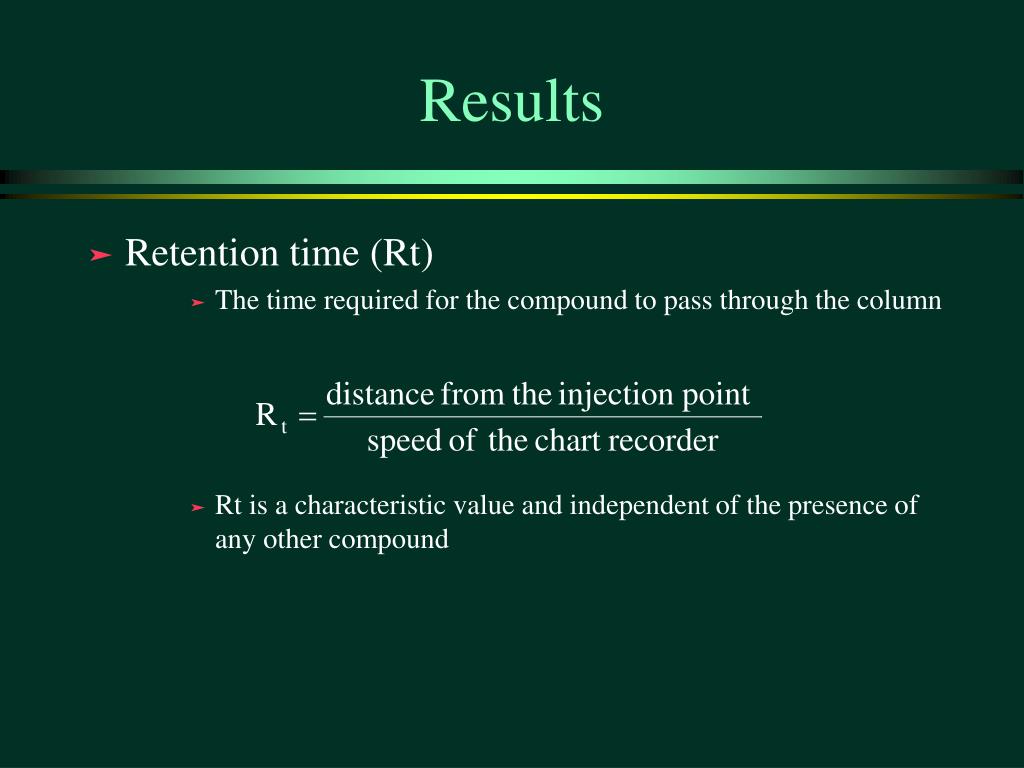
Calculating the retention time : What is the retention time for peaks a and b below if the chart speed. The retention time is calculated according to the following equation:
The Sample Is Evaporated In An Injector Heated At About 200 To 300 °C.
Of particular interest in a separation is the dead time t m, which is the time a nonretained molecular species needs to elute from the chromatographic column. Determine the distance between the spotting line and the compound of interest's distance traveled as. Chromatographic peak resolution is given by = + where t.
This Lesson Is An Introduction To Basic Concepts In Column Chromatography.
Retention time (rt) is a measure of the time taken for a solute to pass through a chromatography column. F) the retention factor (k) is the ratio of the amount of analyte in the stationary phase to the amount in the mobile phase. The retention time and the retention index are important parameters in qualitative analysis.
It Is Calculated As The Time From Injection To.
How do you calculate retention factor in gas chromatography? Yes, i've found this relationship but i don't know how to calculate peak width: Soren, yes you can use reversed phase chromatography to calculate the hydrophobicity of your compounds and there are several references dealing with this (i.e.
These Retention Parameters Will Be Explained Here.
This can be compared to other sample data or data generated. A longer column will produce longer retention times but better. Relationships are derived for calculating the retention time and peak width at the column outlet for any temperature programme in the column oven.


Comments
Post a Comment